4–10 people
Cyber Attack team battle
Two indoor teams compete at the same time.
Experience Scrum principles and agile methods firsthand in escape rooms
Plan now instead of reading first
These three routes lead directly to the right booking or enquiry.
Two indoor teams compete at the same time.
Play outdoors in up to four teams of eight people.
Start several rooms together – send us your date, language and requirements.
You know the drill: Sprint Planning takes longer than the sprint itself, in the Daily Standup one person talks for 20 minutes about their bug fix from yesterday, and in the Retro it's "we should communicate more" again. Sound like a typical Monday? Then we have the solution: Send your team to an escape room!
60 minutes, one room, one goal – and suddenly all agile principles work automatically. No PowerPoint presentation about teamwork, but real action. Here we'll show you why escape rooms are the ultimate playground for Scrum teams.

Imagine: A sprint, but WITHOUT endless meetings. A retro that's actually fun. And a standup where everyone actually stands (because the chairs are locked away). Welcome to the escape room – every Scrum Master's dream!
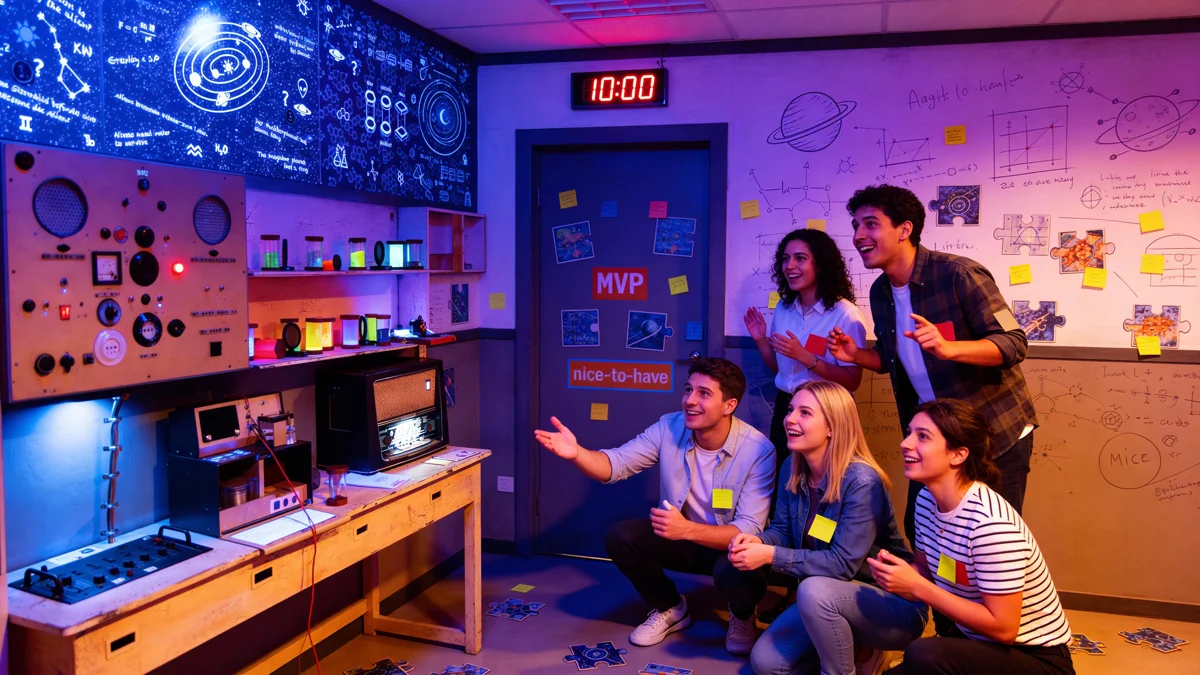
60 minutes = One compact sprint: You have a clear sprint goal (get out of the room!), an iron timebox (the clock ticks mercilessly), and a self-organizing team (because the product owner can't interfere this time – they're sitting outside). Only difference: Here there's no "let's move it to the next sprint." Either you make it, or the secret society wins. No pressure! 😅
The ideal escape room team size is 3-6 players – right in the sweet spot for Scrum teams! That's all you need. Less gets tight.
Indoor competition: In the Cyber Attack team battle, 4–10 people compete in two teams at the same time.
Outdoor for up to 32 people: Safe House or Skywatch can be played in up to four teams of eight.
Tailored combination: We can coordinate several rooms for the same starting time. Email your group size, preferred date, language and any special requirements to info@illuminati-escape.com.

You know: "Communication is important." It's in every Scrum Guide. You've heard it a hundred times. But in the escape room? You'll learn it in 60 seconds!
The game master listens to you through microphones and gives subtle hints when you're stuck. Just like your Scrum Master – except the game master doesn't ask: "Have you thought about the retrospective board?" but just makes the lights blink. Subtle. Effective. 👌
In the office: "Can we split that user story again?" In the escape room: "YOU take the lock, I'll search for clues!" – Boom, task distribution done!
| Scrum Concept | Escape Room Equivalent |
|---|---|
| Sprint Backlog | List of puzzles to solve |
| Task Assignment | "You take the combination lock, I'll search for clues" |
| Definition of Done | Puzzle solved, lock opened, next room accessible |
| Sprint Goal | Escape the room in 60 minutes |
| Impediments | Getting stuck on a puzzle |
The clock ticks. Mercilessly. Like in your last sprint before the release. Except here NOBODY really says: "Can we postpone the deadline?"
A typo in the code – uh, in the combination LOCK – and suddenly nothing opens. Sound familiar? 🐛
Did a bug sneak into the puzzle solution? A team meeting helps you for the last-minute release! Swap out the person at the lock. Sometimes you just need fresh eyes (or fingers!). Like in pair programming: "I type, you watch" – except here really nobody is scrolling through their phone! 😄
After the game comes the best part: the retrospective! And this time EVERYONE really has something to say (not just "well, things went pretty well for me...").
The escape room shows you under pressure how your team REALLY ticks: Who takes leadership when it counts? Who keeps the overview? Who finds the most creative solutions? And who shouts "TIME!" the loudest? You can take these insights 1:1 to the office – except hopefully nobody's locked up there! 😅
| Criterion | Escape Room | Traditional Team Events |
|---|---|---|
| Agile Principles | ✓ Directly applicable | ✗ Usually abstract |
| Time Required | ✓ 90 min. incl. briefing | ✗ Often half-day |
| Weather Independent | ✓ Indoor activity | ✗ Often outdoor |
| Central Location | ✓ Berlin Charlottenburg | ~ Varies |
| Team Size | ✓ 3-6 (or versus) | ~ Often large groups |
| Fun Factor | ✓ Very high | ~ Varies |
| Practical Relevance | ✓ 1:1 transferable to work life | ~ Often symbolic |
Forget bowling, climbing parks, and "trust exercises." At Illuminati Escape in Berlin Charlottenburg, 4 exciting missions await you that will really put your agile skills to the test! Whether classic escape rooms or Cyber Attack in versus mode – here you'll learn more about teamwork than in any workshop. Guaranteed!
Contact Us and We'll Plan Your Event Together!Your first escape room? This guide shows you all the important tips and tricks for beginners – from teamwork to systematic searching to the most important rules!
Read NowThe story behind Illuminati Escape: How 340 sqm of empty factory space became Berlin's most unique escape rooms.
Read NowEscape rooms with children - at what age does it make sense? Why multi-generation teams are unbeatable and what to consider for kids' birthdays.
Read Now