You know the drill: Sprint Planning takes longer than the sprint itself, in the Daily Standup one person talks for 20 minutes about their bug fix from yesterday, and in the Retro it's "we should communicate more" again. Sound like a typical Monday? Then we have the solution: Send your team to an escape room!
60 minutes, one room, one goal – and suddenly all agile principles work automatically. No PowerPoint presentation about teamwork, but real action. Here we'll show you why escape rooms are the ultimate playground for Scrum teams (and why your next team building definitely should NOT be bowling).
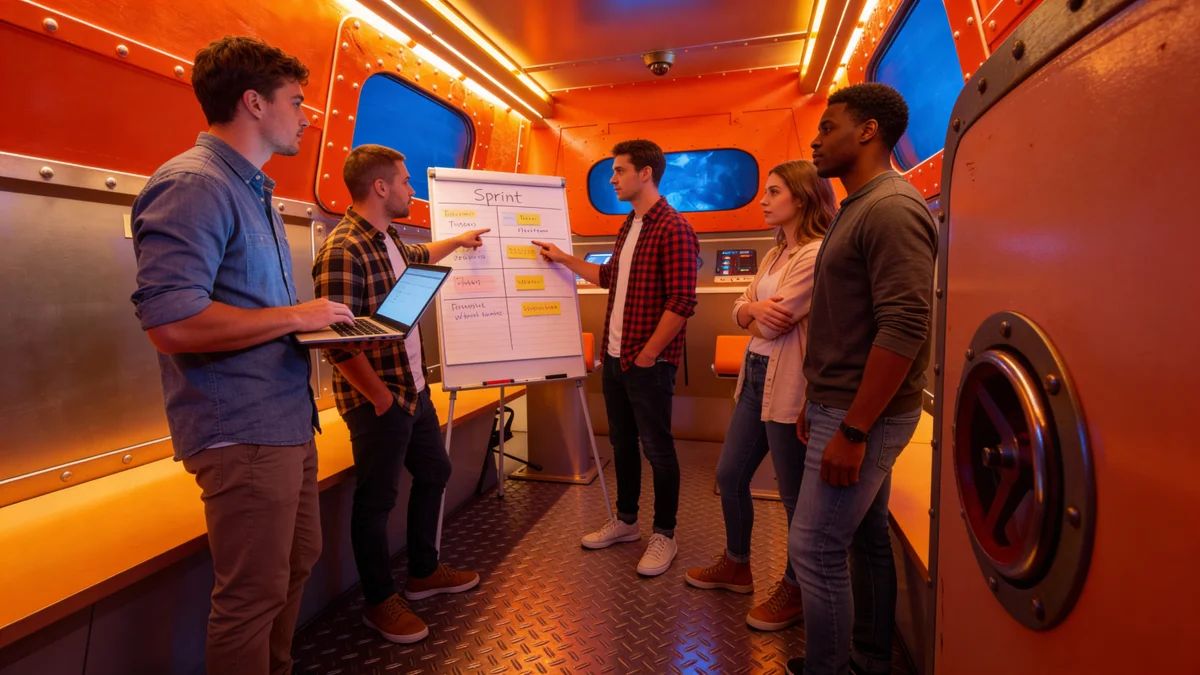
Why Escape Rooms Are the Perfect Playground for Agile Teams
Imagine: A sprint, but WITHOUT endless meetings. A retro that's actually fun. And a standup where everyone actually stands (because the chairs are locked away). Welcome to the escape room – every Scrum Master's dream!
The Escape Room as a Sprint (just faster and more exciting)
60 minutes = One compact sprint: You have a clear sprint goal (get out of the room!), an iron timebox (the clock ticks mercilessly), and a self-organizing team (because the product owner can't interfere this time – they're sitting outside). Only difference: Here there's no "let's move it to the next sprint." Either you make it, or the Illuminati win. No pressure! 😅
Agile Principles in the Escape Room
1. Optimal Team Size (or: Why "Two-Pizza Teams" Work in Escape Rooms Too)
The ideal escape room team size is 3-6 players – right in the sweet spot for Scrum teams! That's all you need. Less gets tight.
- Too small teams (1-2 people): "I'm searching for clues!" – "Me too!" – "Then who's solving the puzzles?" – "Uh..." 🤔
- Optimal teams (3-6 people): One searches, two combine, one keeps the overview, and one shouts "TIME!" – perfect!
- Too large teams (7+ people): Know that feeling when suddenly 12 people chime in during a refinement meeting? That's EXACTLY how an overcrowded escape room feels. Pure chaos!
For Larger Departments (Yes, Even Those with 50 People in Refinement)
Cyber Attack or Titanik 2.0: Larger teams? No problem! Split up like in Scrum-of-Scrums: In Cyber Attack, two teams clash in direct competition (may the better daily standup win!). In Titanik 2.0, up to 9 players work together – essentially an optimal feature team!
Whole department on board? At Illuminati Escape, up to 32 players can compete simultaneously in small teams across all rooms. Perfect for your next department offsite – except here everyone actually participates (and doesn't secretly check emails)! 😄

2. Communication is Key (or: The Daily Standup You REALLY Need)
You know: "Communication is important." It's in every Scrum Guide. You've heard it a hundred times. But in the escape room? You'll learn it in 60 seconds!
- "I found a key!" – The perfect status update! Short, snappy, relevant. (Not: "So yesterday I was working on the key feature and noticed three other things...")
- "Who's working on which puzzle right now?" – Avoiding duplicate work (Otherwise everyone solves their own combination lock but nobody opens the DOOR)
- "I'm stuck on this code – can someone help?" – Making impediments transparent (Finally someone says it!)
- "This note might belong to that combination lock!" – Knowledge sharing at its finest
Game Master = Scrum Master (just cooler)
The game master listens to you through microphones and gives subtle hints when you're stuck. Just like your Scrum Master – except the game master doesn't ask: "Have you thought about the retrospective board?" but just makes the lights blink. Subtle. Effective. 👌
3. Organized Approach (or: Finally a Backlog Everyone Understands!)
In the office: "Can we split that user story again?" In the escape room: "YOU take the lock, I'll search for clues!" – Boom, task distribution done!
| Scrum Concept | Escape Room Equivalent |
|---|---|
| Sprint Backlog | List of puzzles to solve |
| Task Assignment | "You take the combination lock, I'll search for clues" |
| Definition of Done | Puzzle solved, lock opened, next room accessible |
| Sprint Goal | Escape the room in 60 minutes |
| Impediments | Getting stuck on a puzzle |
- Divide the puzzles: Not everyone works on the same problem
- Prioritize: Which puzzles need to be solved first?
- Synchronize: Regular updates on progress
- Pair programming: Tackle difficult puzzles in pairs
4. Time Management (Time-Boxing for the Last-Minute Release)
The clock ticks. Mercilessly. Like in your last sprint before the release. Except here NOBODY really says: "Can we postpone the deadline?"
- Timeboxing: "We'll give this puzzle 5 more minutes, then we'll do something else!" (You know this from sprint planning: After 45 minutes of discussion, just make a decision!)
- Setting milestones: "After 20 minutes we should be in the second room" – just like "After the first sprint we should have the login finished"
- Observing velocity: "We solve an average of 3 puzzles per 15 minutes" – except here the velocity REALLY means something!
- Scope adjustment: 10 minutes left, 5 unsolved puzzles? Time for prioritization! (What's your MVP? The door! The rest is nice-to-have.)
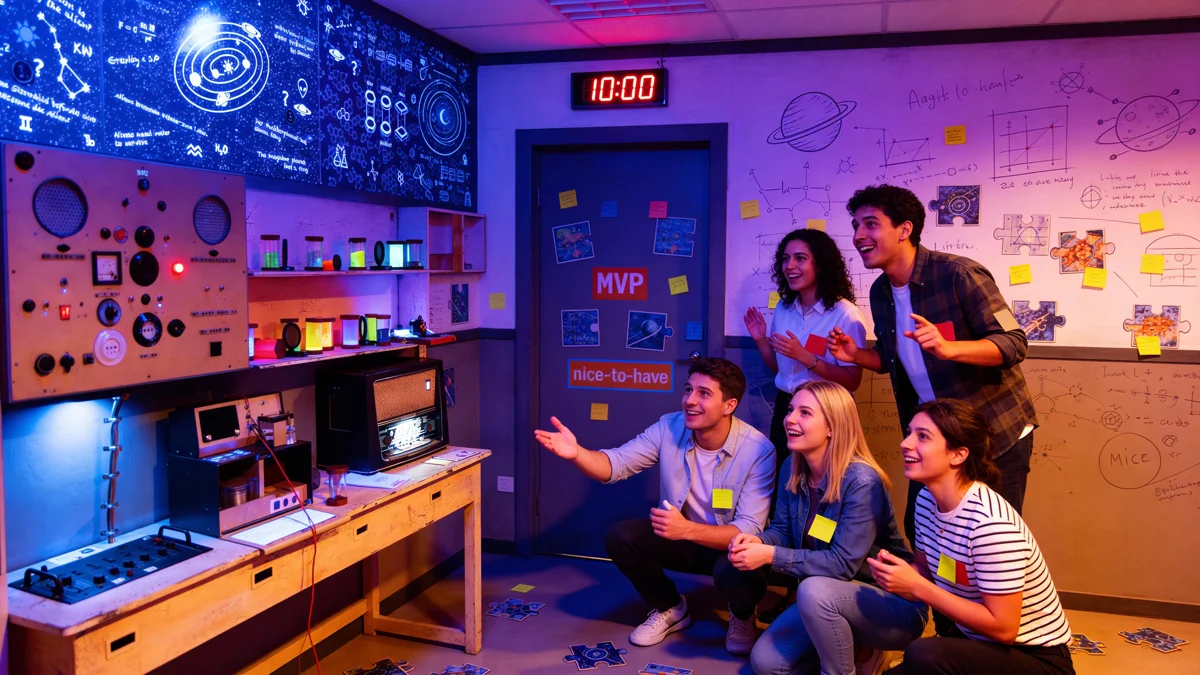
5. Bug Tracking (or: "Did a Bug Sneak into the Puzzle?")
A typo in the code – uh, in the combination LOCK – and suddenly nothing opens. Sound familiar? 🐛
- Code reviews: "Can you double-check if I entered the code correctly?" (Four-eyes principle saves lives – and escape room records!)
- No technical debt: "Ah, let's just try all combinations!" – NO. Be thorough. A wrong code = 5 minutes gone = no release!
- Debugging: Lock won't open? Time for systematic debugging: Right code? ✓ Right lock? ✓ Right order? Uh... 🤔
- Quality assurance: Better check one more time than realize at the last puzzle that you made a mistake at puzzle 2 (Technical debt, anyone?)
The Code-Swap Trick (Pair Programming Saves the Day!)
Did a bug sneak into the puzzle solution? A team meeting helps you for the last-minute release! Swap out the person at the lock. Sometimes you just need fresh eyes (or fingers!). Like in pair programming: "I type, you watch" – except here really nobody is scrolling through their phone! 😄
The Escape Room Retrospective (finally a retro with real content!)
After the game comes the best part: the retrospective! And this time EVERYONE really has something to say (not just "well, things went pretty well for me...").
Retro questions that actually have answers this time:
- What went well? "When you shouted 'KEY!' that was EXACTLY the info I needed!" (Communication level: Expert!)
- What went poorly? "Why did we work on the SAME puzzle for 15 minutes without noticing?" (Classic case of missing synchronization!)
- What did we learn? "Maybe in the daily we should also say what we're NOT working on?" 💡
- What do we take with us? "If we communicate as clearly in the sprint as in the escape room, we're unbeatable!"
Team Building Effect (The Moment of Truth!)
The escape room shows you under pressure how your team REALLY ticks: Who takes leadership when it counts? Who keeps the overview? Who finds the most creative solutions? And who shouts "TIME!" the loudest? You can take these insights 1:1 to the office – except hopefully nobody's locked up there! 😅
Escape Room vs. Traditional Team Building Activities
| Criterion | Escape Room | Traditional Team Events |
|---|---|---|
| Agile Principles | ✓ Directly applicable | ✗ Usually abstract |
| Time Required | ✓ 90 min. incl. briefing | ✗ Often half-day |
| Weather Independent | ✓ Indoor activity | ✗ Often outdoor |
| Central Location | ✓ Berlin Charlottenburg | ~ Varies |
| Team Size | ✓ 3-6 (or versus) | ~ Often large groups |
| Fun Factor | ✓ Very high | ~ Varies |
| Practical Relevance | ✓ 1:1 transferable to work life | ~ Often symbolic |
Summary: Agile Principles in the Escape Room
- ✓ Optimal team size (3-6 people)
- ✓ Intensive communication
- ✓ Structured task management
- ✓ Time-boxing (60 minutes)
- ✓ Pair programming for difficult puzzles
- ✓ Continuous feedback
- ✓ Making impediments transparent
- ✓ Quality assurance (no careless mistakes)
- ✓ Retrospective after the sprint
- ✓ Self-organizing teams
Ready for Your Agile Team Adventure?
Forget bowling, climbing parks, and "trust exercises." At Illuminati Escape in Berlin Charlottenburg, 4 exciting missions await you that will really put your agile skills to the test! Whether classic escape rooms or Cyber Attack in versus mode – here you'll learn more about teamwork than in any workshop. Guaranteed!
Contact Us and We'll Plan Your Event Together!Frequently Asked Questions (FAQ)
More Interesting Articles
Escape Room for Beginners: The Ultimate Guide
Your first escape room? This guide shows you all the important tips and tricks for beginners – from teamwork to systematic searching to the most important rules!
Read Now